
Arguably, one of the most common mistakes a junior programmer can make is creating an endless loop. It is also one of those learning moments that sticks with you for your entire career.
So what did I do this time?
I took a perfectly good free-form RPG program and handed it over to AI. I asked it to modernize things—convert subroutines that relied on global variables into proper modules and procedures.
Now, to be fair, the compiler had already been complaining long before I brought AI into the mix:
“Subroutines should not be defined in the global scope.”
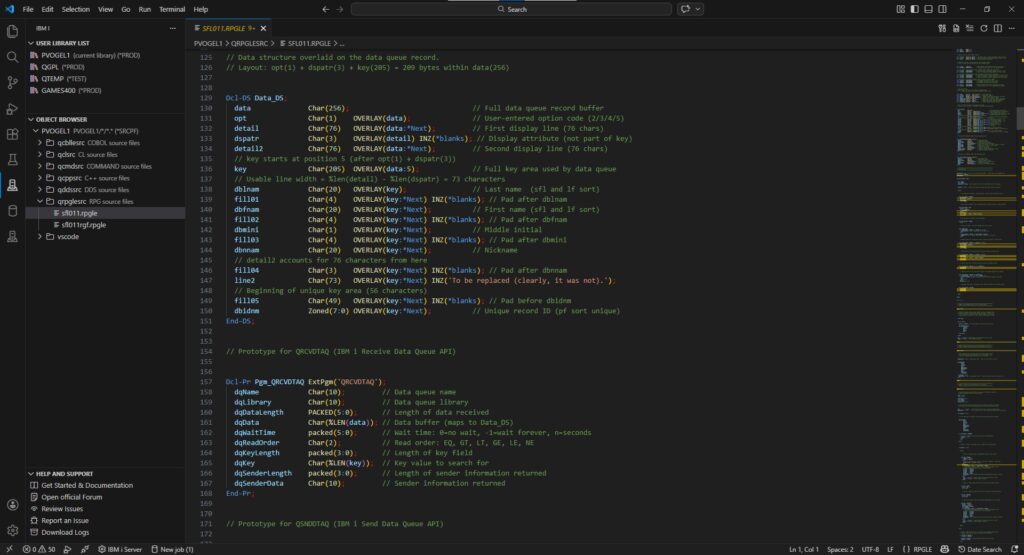
Alright. Fair enough. Let us see how well AI can really write code.
At first glance, it looked incredible. Clean modules, structured procedures—honestly, it was beautiful. I thought, “Wow, I will just cut, copy, paste, compile, and be done.”
That optimism lasted about five minutes.
I compiled four modules and rebuilt the program. A few errors popped up. No big deal, I thought. Maybe just some formatting quirks. I recompiled a few times.
Now, if you remember, “a few” usually means somewhere between three and five. In this case? It was closer to twenty.
Fine. I can fix things. Case sensitivity issues—no problem. Apparently, neither the compiler nor the AI could agree that LastName, LASTNAME, and lastName might actually be the same field… even though I defined it as lastname. The “fancy casing” was entirely AI’s idea.
Still, I forgave it. The code looked great.
Then I ran the program.
Nothing.
No screen. No file activity. No output. Just… nothing.
What is happening?
Time to debug.
Initialization? Fine. Constants? Fine. File pointer set to the beginning? Sure. But wait… should the file have been opened before setting the pointer? That seems important. No error, though. So onward I went.
Line three.
That is where everything fell apart.
An endless loop.
Right there. Line three.
AI cannot rewrite a program past line three without a catastrophic failure—even when the original program already worked.
And yet, everywhere I look, people are hyping AI. Accountants, zoologists—you name it. Suddenly everyone is a programmer because they got a script to run once.
Or did it?
The confidence is what gets me. It reminds me of that one person at work or school who always has the answer—whether it is correct or not.
“I have seen AI write a whole program.”
Okay… but did it work?
Because mine does not. Mine is stuck in an endless loop.
So here we are—right back where we started.
An endless loop.
I wrote the original program in Visual Studio Code. The syntax highlighting is beautiful. Everything looks modern and polished. And yet, here I am again… debugging like it is the 1990s, staring at green screen output because I have not learned the new debugging tool.
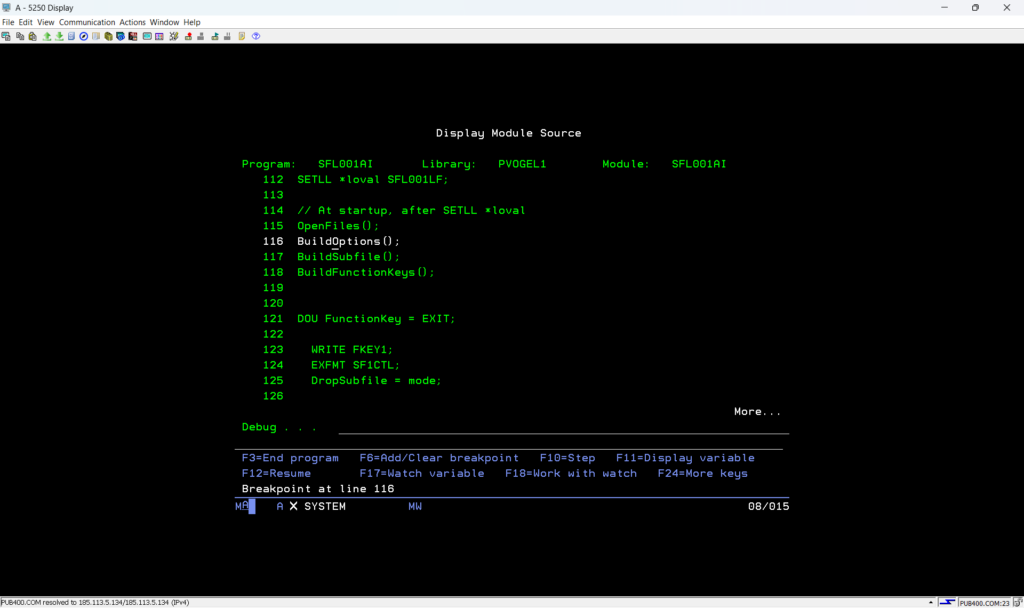
AI can sound incredibly smart. It can even clean up this very article—fix my spelling, correct my grammar, organize my thoughts.
But today?
It cannot get past line three.
The truth is, the internet has always been full of questionable code. Back in the 90s, it was magazines. And yes, those had bugs too. But we worked through them. We learned.
Now we have blogs, repositories, endless shared snippets… and honestly, a lot of it still does not work out of the box.
So here is where I come in.
I love coding. And I am going to start a blog.
Not just another collection of half-working examples—but something practical. Something tested. Something real.
Code that actually runs.
Free.
You will get to see the process. The successes, the failures, the debugging sessions.
Maybe I will learn something.
Maybe you will too.
And who knows… maybe a stranger reading it today becomes a friend—or even a client—tomorrow.
-
Three Decades, Three Seasons
Over the last three weekends, my wife and I celebrated our birthdays and our anniversary. We are also in the third season of the year, autumn, with September, October, and November marking…
-
What I Thought Vogel Consulting Would Be
On October 1, 2025, I launched Vogel Consulting. I had spent more than 30 years working with ERP systems, IBM i, business processes, integrations, and the technology that supports day-to-day operations. I…
-
The Power of 26 Seconds
A client recently came back to me with a question about something that had come up during an earlier meeting. My first thought was that I needed to go back and look…
